AI Code Audit: What It Covers, When You Need One, and How It Differs from Scanners
Enterprise buyers and auditors are no longer asking whether your team uses AI coding tools. They assume you do. The harder questions are landing in security questionnaires, diligence rooms, and compliance reviews: which code was AI-assisted, who reviewed it, and what evidence proves it is safe to run in production?
If your engineers ship with GitHub Copilot, Cursor, or similar assistants, velocity is real, and so is the review gap. Automated scanners catch some issues. They do not replace a senior engineer who can judge architecture, licensing exposure, and regulatory intent. That gap is exactly what an AI code audit is designed to close.
If your search is specifically about GitHub Copilot or Cursor risk, start with Copilot & Cursor code audit.
This guide explains what an AI code audit is, what it should cover, how it differs from ongoing oversight or a scanner-only pass, and when to hire an independent review before your next forcing function.
What is an AI code audit?
An AI code audit is a fixed-scope, point-in-time review of code that was produced or heavily assisted by AI tools. Senior engineers inspect a defined repository scope, deliver a severity-ranked written findings report, and walk your team through remediation priorities.
It is the right engagement when you need answers before a deadline, not an open-ended retainer. Typical triggers include fundraising diligence, an enterprise security questionnaire, a HIPAA / SOC 2 / FedRAMP review, an acquisition, or a production incident tied to unreviewed AI output.
At Maxiom, audits are conducted by named senior engineers. Scope is agreed up front. Client code stays in client environments. We do not run proprietary source through third-party AI tools as part of the review.

Why AI-assisted code needs a different review bar
AI coding assistants accelerate merges. Review capacity usually does not. The failure mode is not “AI writes bad code every time.” It is subtler:
- Security patterns that look correct but fail on authorization edges
- Architectural shortcuts that couple modules your roadmap cannot afford
- Hardcoded secrets, weak error handling, and unvetted dependencies
- Compliance gaps, especially around PHI, audit logging, and minimum-necessary access
- Prompt-injection exposure when LLM features sit next to sensitive data paths
Scanners help. They do not understand your system design, your BAA constraints, or whether a “working” feature is production-ready for a regulated buyer. For a practical risk list your team can reuse, see the free AI Code Risk Scorecard.
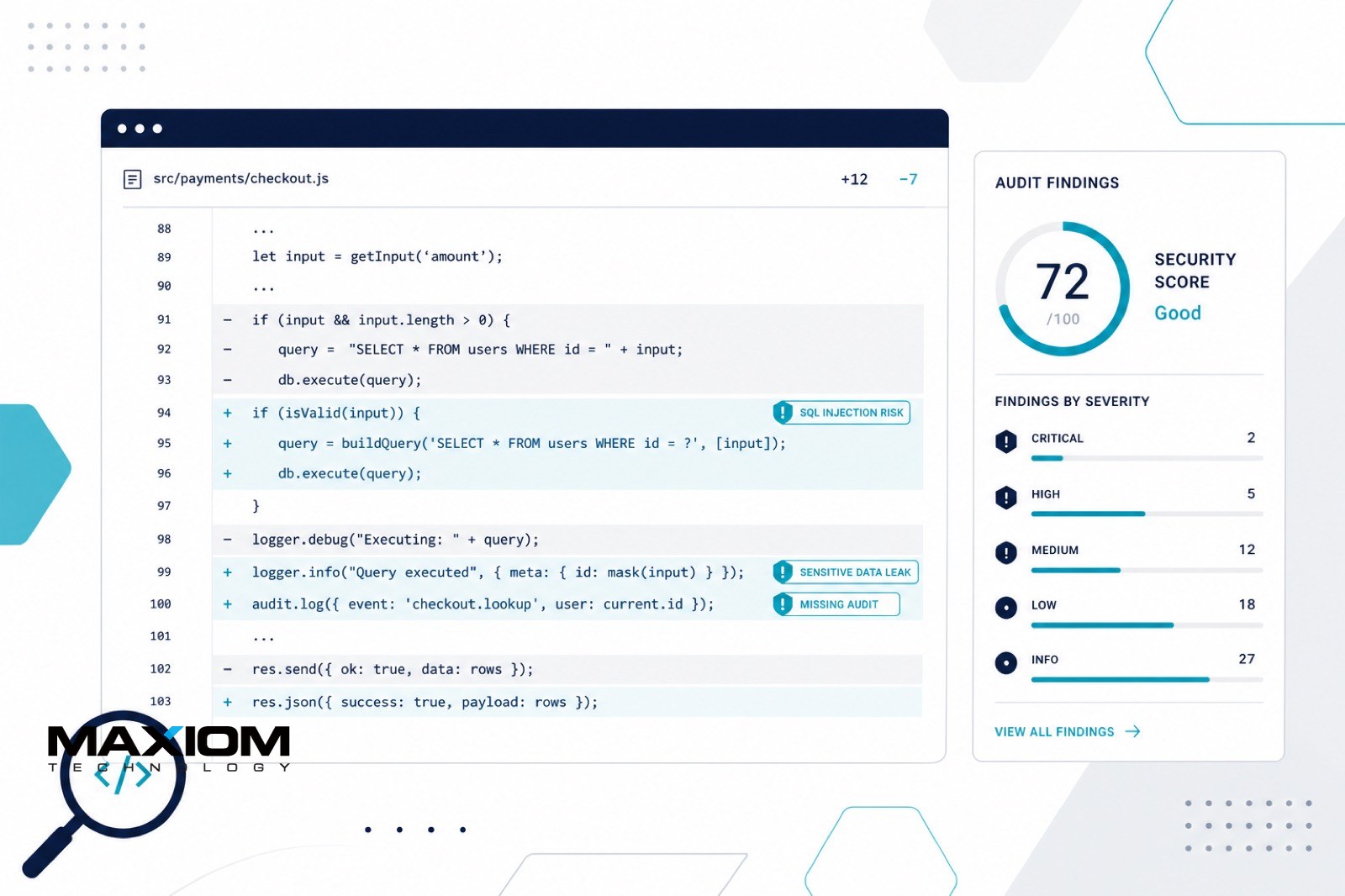
What a strong AI code audit covers
A credible audit is more than a lint pass with a fancy label. Expect coverage across five pillars:
- Security analysis (OWASP-class issues plus AI-specific patterns such as prompt injection in LLM-integrated features
- Architecture review) against your stated design and near-term roadmap
- Compliance gap analysis (mapped to your framework (HIPAA/FHIR, SOC 2, FedRAMP/NIST) when in scope
- Dependency and licensing review) supply-chain risk, copyleft contamination, unvetted packages
- Test quality on critical paths. Coverage that matters, not vanity percentages
Deliverable quality matters as much as scope: severity-ranked findings, remediation guidance, and a live debrief with a senior engineer who can defend the recommendations.
AI code audit vs oversight vs scanners
Teams often conflate three different things. Keep the distinction sharp:
| Approach | Best for | What you get |
|---|---|---|
| AI Code Audit | Deadline, diligence, incident, questionnaire | Point-in-time written findings + debrief (typically days, not months) |
| AI Code Oversight | Teams already shipping with AI tools weekly | Ongoing senior review as velocity continues |
| Automated scanners / AI PR bots | Always-on hygiene in CI | Pattern matches. Valuable, incomplete without human judgment |
| AI-generated code review | Recent AI-written changes before merge/launch | Focused senior pass on a narrower slice of work |
If the product was built primarily through prompting rather than an established engineering team, start with vibe coding governance instead. The readiness bar is different.
What auditors and enterprise buyers will ask
Use this as a leadership checklist before the next review cycle:
- Which AI coding tools are approved, and which are prohibited? If that answer is still a Slack thread, write an AI coding policy engineers will follow first.
- How do you detect AI-assisted changes in pull requests?
- Who reviews AI-generated code before merge, and at what seniority?
- What security and compliance checks run in CI for AI-touched paths?
- Can you show evidence of findings, overrides, and remediation?
- How is proprietary code prevented from leaking into public model contexts?
- For healthcare or federal work: do controls for PHI, logging, and access meet framework expectations in code, not only in policy?
- Have you assessed licensing risk introduced by AI suggestions and dependencies? Scanners read declared packages. They do not read generated snippets. That gap is Copilot does not check the license.
- What is the plan when a scanner is clean but architecture still looks wrong?
- Who owns remediation after an independent audit?
If you cannot answer these with artifacts, you are not ready for a serious buyer or auditor. Regardless of how fast the team ships. “Human in the loop” on the questionnaire is a process claim, not that packet: see why that sentence no longer holds. For the buy decision (snapshot vs monthly retainer vs governed MCP) see AI code oversight vs audit: which to buy first. If the assessor language is Type II change management, start with the SOC 2 AI code audit.

When to hire an independent AI code audit
Internal review can be enough when stakes are low, the blast radius is small, and senior reviewers already have capacity.
Hire an independent audit when any of these are true:
- A fundraise, acquisition, or enterprise sale depends on a clean technical narrative
- You handle PHI, payments, or government data and face HIPAA, SOC 2, or FedRAMP pressure
- AI velocity clearly outpaced review quality over the last one to two quarters
- A production incident or failed questionnaire already pointed at unreviewed AI output
- Leadership needs an external, written baseline before investing in ongoing oversight
Regulated teams should also connect audit findings to compliance engineering. Building encryption, access control, and audit logging into the system so the next assessment has code-level evidence. Healthcare product work may also pair with HIPAA software development or Maxiom’s healthcare practice at Maxiom Labs.
How an AI code audit engagement typically runs
- Scope and NDA (define repositories, frameworks in scope, and success criteria
- Read-only access) least-privilege repository access; no broad production credentials by default
- Senior inspection (security, architecture, compliance, dependencies, and tests
- Findings report) severity-ranked issues with remediation guidance
- Live debrief. Walkthrough with engineering and, when needed, GRC or leadership
Standard Maxiom audits share initial findings within about five business days after access and scoping, with full report and debrief commonly inside 5–10 business days depending on size and regulatory depth.
FAQ: AI code audits
Is an AI code audit the same as a penetration test?
No. A pentest probes running systems for exploitable weaknesses. An AI code audit reviews source and design decisions in AI-assisted codebases, including architecture and compliance gaps a pentest may never surface.
Will scanners alone satisfy auditors in 2026?
Unlikely for serious buyers. Expect questions about policy, tool inventory, human review, and evidence of enforcement, not only green CI badges.
Does Maxiom use our code to train models?
No. Client code stays in client environments. Audits are direct inspection by senior engineers.
Can an audit map to HIPAA or SOC 2?
Yes, when scoped that way. Findings can be framed against the controls and evidence your assessors or customers care about.
Should we start with audit or oversight?
Start with an audit when you need a snapshot before a deadline. Move to oversight when you want continuous senior judgment as the team keeps shipping with AI tools. A longer decision tree is in audit vs oversight vs MCP.
How is repository access handled?
NDA first, then read-only access by default. Build access is only added if you engage remediation afterward.
What if our app was mostly vibe-coded?
Use vibe coding governance for prompt-built products. Use an AI code audit when an established team used assistants inside a normal engineering process.
If the next problem is connecting agents to internal systems rather than reviewing the code they write, see custom MCP servers for enterprise AI.
Next step
If a questionnaire, diligence process, or compliance review is already on the calendar, do not wait for the first failed answer. Request an AI code audit, explore the Copilot & Cursor audit, the SOC 2 AI code audit, download the AI Code Risk Scorecard, or talk through whether ongoing AI code oversight is the better long-term control. If the question is unattended Claude Code sessions rather than what already merged, use the auto mode checklist.